- Shiny Thing$
- Posts
- 💹 $T Archives: Steve Jobs' Greatest Gift


Steve Jobs' Greatest Gift: Pettiness
As we hit the 228th installment of Shiny Things—and approach Apple’s 50th anniversary this April - we went back into the archives. This week, we’re revisiting Issue 108, written by our friend and former Rally content lead Will Stern: a short story on the lore of Steve Jobs that feels just as relevant today as it did in 2023.
originally written by Will Stern, for Rally
· · · · · · · ·
The lore of Steve Jobs knows no bounds.
Visionary.
Technologist.
Titan of Industry.
The first tech rock star.
But above all, Jobs was at his best when he was being petty. The man loved a grudge and he wasn't afraid to show it. And over the years, Jobs set his sights firmly and relentlessly on IBM.
The bloodshed began in 1981, when, 5 years after Apple's founding, IBM announced they'd be entering the PC market.
Just a year earlier, Apple went public, opening at $22 / Share and a Market Cap. of $1.2B. In 1981, IBM was listed as No. 8 on Fortune 500's list of America's largest corporations.
IBM's threat to infringe upon Apple's territory was more than the emergence of healthy competition. It spelled death for the young company.
Jobs, predictably, didn't back down.
In fact, he decided to poke the bear.
In August 1981, Jobs placed a full-page ad in the Wall Street Journal.
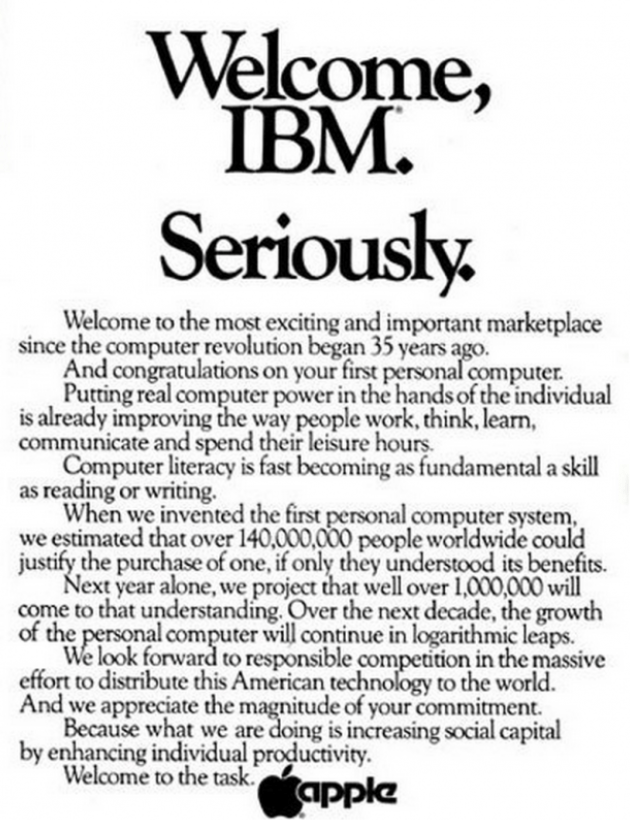
This was just a warning shot across IBM's bow.
Soon IBM would announce the production of the IBM PCjr (AKA "Peanut"), a low-cost home computer with the obvious goal of competing directly with the Apple II. Expectations were sky-high as the massive computing giant poured marketing dollars into the launch of their new product.
The Washington Post cited IBM's position as "one of the biggest companies in the world" to justify the prediction that they were "uniquely positioned to serve the consumer market."
The November 1983 headline read: "IBM PCjr leads the way for industry"
The PC was hampered by production issues which caused the release to be pushed back past the intended holiday season release days.
Jobs and Apple used that time to land a sucker punch in what would become one of the most famous advertisements in history during the Super Bowl: "1984"
The Ridley Scott-directed dystopian reference to George Orwell's Big Brother, was an oblique comparison of the conformist, establishment IBM to the bleak future envisioned in the book. (Orwell's estate actually sent a cease-and-desist letter to Apple for the use of the ad).
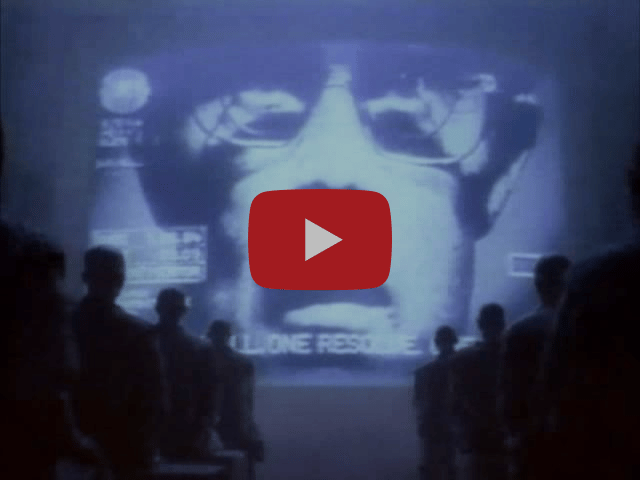
Apple’s legendary “1984” Commercial
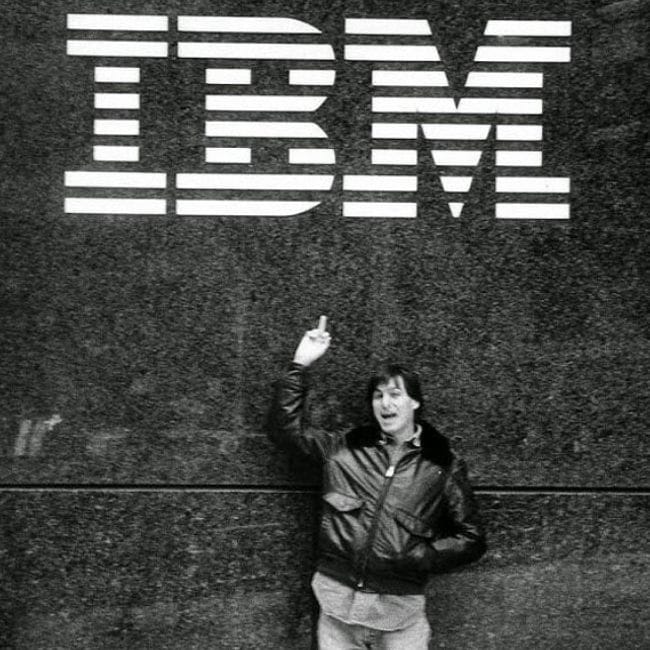
As the face-off drew near, Jobs would take one last parting shot at IBM during a Macintosh team trip to NY.
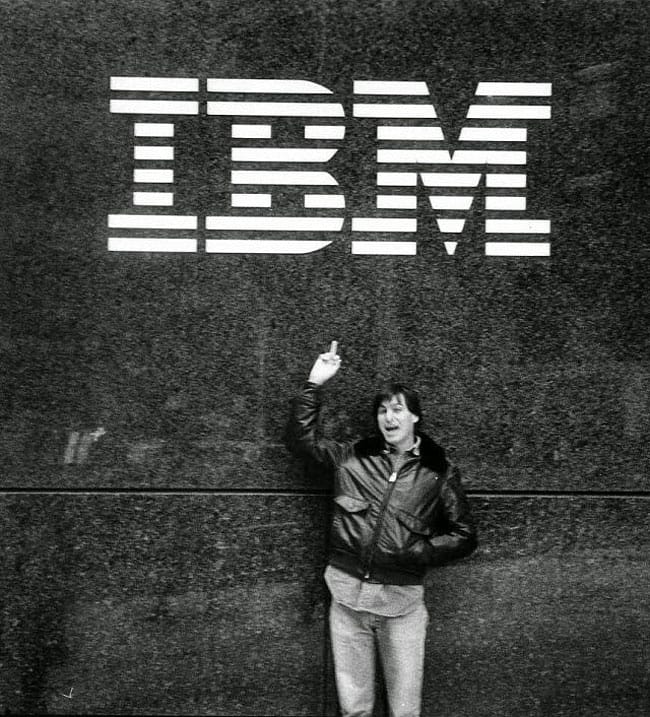
He posed outside the IBM building, wearing a leather jacket & flipping off the evil empire.
In their coverage leading up to the launch of the PCjr, the New York Times marked IBM's move into the home computing market by proclaiming Apple as the "main victim" poised to lose market share.
Compute! Magazine declared: "Never before in the history of personal computing (admittedly a brief history) has a product been so eagerly awaited by so many."
The exuberance would soon fade as consumers got a taste of the product in March 1984. Sales projections fell short as the PCjr failed to meet expectations, leaving many to decide they preferred Apple's machine — even at its premium price point. Among the issues noted by critics included a lackluster keyboard, which placed keys inconveniently far apart from one another. Add in a dose of complaints regarding its computing power and the PCjr went from the hottest ticket in computing to immovable inventory.
By April, IBM was forced to acknowledge that the PC was not selling as they'd hoped. According to Popular Computing, Apple sold more Apple IIcs on its launch day (50,000) than IBM sold PCjrs during the entirety of its first run.
The result was full-on crisis mode. IBM embarked on its largest-ever marketing campaign ($32.5M in advertising spend) in 1984. the price was reduced and sales did tick up — eventually beating out Apple for a period of time before its discontinuation in March 1985.
· · · · · · · · · · · ·
Until Next Week…