- Shiny Thing$
- Posts
- Bullish on Math ~ Bearish on Magic 🪄


Bullish on Math, Bearish on Magic…
Rob Petrozzo, for Rally
· · · · · · · ·
This weeks Shiny Thing$ is dedicated to brainpower in the face of pure emotion - because these days, particularly In collectibles perhaps more than anywhere else, both forces matter. Passion, nostalgia, and cultural meaning are what give objects their gravity, but the balance between emotional pull and mathematical reality is constantly shifting.
Finance, like most long-standing institutions, has accumulated a library of sayings, analogies, and idioms that turn into memes and then eventually turn into incorrectly used nonsensical replies on twitter. Many of them survive because they capture something fundamental about human behavior around money. Others have been adopted by newer participants in the markets, often younger and way too enthusiastically, without much context.
Over the years I’ve heard nearly all of them just as I’m sure many of you have. “Don’t throw the baby out with the bathwater” was a personal favorite that I definitely overused for most of the 2000s…
But one phrase I came across earlier this week stood out in a way the others rarely do: “Bullish on Math, Bearish on Magic.”
I’ll admit I had never heard it before until it surfaced in a Reddit thread on Wednesday discussing modern trading behavior, but the idea stuck with me. In that thread, it referred to a particular type of speculative trade that has become increasingly common among young (maniac) market participants: buying extremely risky 0DTE options contracts (authentic bets on an underlying stock that expire the same day they’re purchased). These trades rely on a dramatic market move occurring within hours - something that, if it happens, can generate enormous returns (or instantly take your account zero). Statistically speaking, the probability of success is extraordinarily small. Struck-by-lightning-while-winning-the-lottery small.
That said, it does happen from time to time (and you’ll see the screenshots littered all over r/WallStreetBets to prove it). From a mathematical standpoint, the outcome borders on impossibility, but from a human standpoint, it’s irresistible. That tension exists because money and hope are usually best friends before the war starts. The belief that “it could happen to me” has a remarkable ability to override even the most rational, previously disciplined, thinking.
We saw an extreme version of this dynamic during the period from 2021 into early 2022, when liquidity was abundant and markets across nearly every category surged simultaneously. In that environment, it often felt as though almost any asset could appreciate if you simply bought it without thinking. Everything was UP.
Eventually, the tide receded. Prices corrected, enthusiasm cooled, and the underlying math began to reassert itself. Interestingly, where we’ve landed since then is something I find genuinely encouraging. Across many categories of collectibles, the objects that have returned to (or exceeded) their Covid stimulus-era highs are overwhelmingly the same pieces that had the strongest underlying fundamentals to begin with. Its not rocket science either - they’re the rarest examples from the culturally enduring icons and they have deep demand pipelines.
In other words, the math [mostly] won.
Speculation on impulsive frothy markets still exists, of course, and theres money to be made there - because the “hope” that something extraordinary might happen will always play a role in markets. But increasingly, that optimism functions more as a supporting narrative around great objects rather than the primary justification for owning them.
Which raises the question: Where, exactly, does the balance between math and magic sit in the collectibles market today? Below are a few corners of the market where that balance is currently taking shape.
And a disclaimer that goes without saying - this is NOT financial advice from me or Rally (at one point not that long ago, I thought Anthony Davis rookie cards were going to buy me a house - you’ve been warned).
Pokémon: When Nostalgia Meets Arithmetic
This is obvious to nearly everyone right now but it deserves commentary because there are still so few collectibles markets that illustrate the balance between emotion and mathematics like Pokémon.
The recent resurgence is was already moving forward all of 2025, but when Logan Paul’s Illustrator card sold through Goldin auctions last month for over $16M, it all went parabolic. The under-the-hood on it is that Pokémon is one of the highest-grossing entertainment franchises in history - larger in lifetime revenue than many media giants, including The Walt Disney Company - which gives the brand an unusually durable demand base. That demand now intersects with true scarcity. High-grade examples of early cards, particularly the 1999 Pokémon Base Set Shadowless Charizard PSA 10, have quietly established price levels in mid six figures. Rally participated in that momentum with a world-record sale of a PSA-10 Base Set just under a million dollars, which would have made very little sense even during the pandemic highs. That said, there are rumors of another set trading privately at an even higher number.
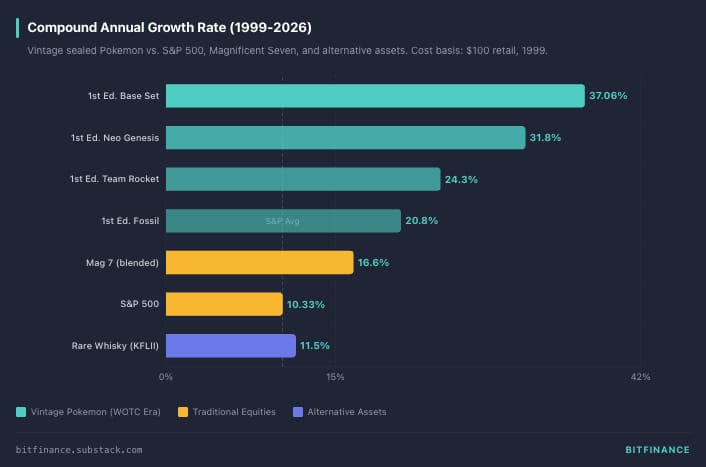
Four different sets of Pokemon are outperforming nearly everything.
The broader story is generational. Collectors who grew up with Pokémon moving from cards to movies to the global phenomenon of Pokémon GO are now entering their peak earning years. When cultural relevance meets genuine scarcity, the math becomes fuel for turning anything into an “asset” (a term we got criticized for using for YEARS by the finance world, which now uses it very liberally).
Sports: The Value of a Moment
A widely debated 83-point performance from Bam Adebayo on Tuesday night quickly reignited familiar comparisons to earlier eras of basketball. Moments like these inevitably draw attention back to players who, by all units of measurement, played in a very different (albeit recent) era. Kobe Bryant, whose 81-point game remains one of the most iconic scoring performances of all time and was DEFINITELY an 81 points that he earned, and Michael Jordan, who dominated during a very different style of play when guards weren’t pulling up to bomb threes all night, get more and more attention every time something like Tuesday night happens. And they should.

Kobe Bryant’s iconic “Grinch” game worn debut signature Kobe sneakers - expected to break records.
Across sports, collectors increasingly value artifacts tied to singular historical moments. Advances in authentication (particularly photo-matching and forensic verification) have strengthened the connection between an object and the exact event it represents, and as such, the value of those moments. At the same time, the supply of the most significant items is shrinking as more move directly into long-term collections. A recent example illustrates the trend: sneakers worn by Michael Jordan during the Olympics and later given to Scottie Pippen sold this week for more than $600,000 despite incomplete provenance. The implication is straightforward: truly significant game-worn artifacts are finite from the real GOATs, and are now (and will continue to be) increasingly difficult to acquire. Based on the gaps between truly important pieces coming to auction over 2025 and early 2026, my bet is they will simply be gone at some point soon.
Current Legends with More History to Write
Some collectibles that already have an element of true rarity are valuable are on hockey stick trajectories because their stories are still unfolding - so the bets are getting made right now at a premium. A Ferrari Enzo, Shohei Ohtani, and even the emerging market for Manga all share the same characteristic: cultural relevance today with the potential for greater historical significance tomorrow.

“Modern” is no longer as speculative as it was once considered, particularly in the collector car market.
The Enzo provides a very recent very clear example, as do many of the more modern Ferrari low-production supercars. At the recent world record setting auction from Mecum Auctions, one particularly special Enzo sold for $17.8M - nearly triple the previous record and far above its roughly $600,000 original price when introduced in 2002. Sports cards are showing a similar shift. In December, a one-of-one card of Shohei Ohtani sold through Fanatics for $3M, placing it among the most expensive cards ever sold (historically a list dominated by vintage names the likes Honus Wagner and Mickey Mantle). Another modern example, a 2025 Topps Chrome Dual Gold Logoman Shohei Ohtani / Aaron Judge, is currently at auction and expected to approach similar levels if not surface it when it sells on March 18th (currently comfortably sitting over $1M) with plenty of time left). In each case, enthusiasm may drive attention, but scarcity, demographics, and measurable demand ultimately determine where prices settle. There is a bit more risk in getting in early on the curve, but the market has made its decision about what matters and the money is getting ahead of it. It happens with stocks, so why not with collectibles?
These are still rough sketches of what the current market looks like, but one trend is increasingly clear: theres a broad deep-pocket driven rush toward the best assets with the numbers, rarity, and story to future-proof them. At Rally we hear rumors every day about what may surface next where the money is headed, but the focus isn’t on chasing everything that appears. It’s about doing the work and securing the pieces that truly matter - whether they’re new, old, or somewhere in between. The shift toward quality is accelerating, and the days of betting blindly on magic are fading quickly.
· · · · · · ·
Until Next Week…